Our Factory Just Completed the amfori BSCI Full Social Audit — What It Means for Your Brand
- Share
- publisher
- WENSFASHION
- Issue Time
- Aug 21,2026
Summary
Our Humen (Dongguan) activewear factory just completed an amfori BSCI Full Monitoring audit by TUV Rheinland (valid through July 2027). Overall rating C with strong A ratings on workers involvement. A BSCI-monitored factory saves your brand weeks of separate social audits.
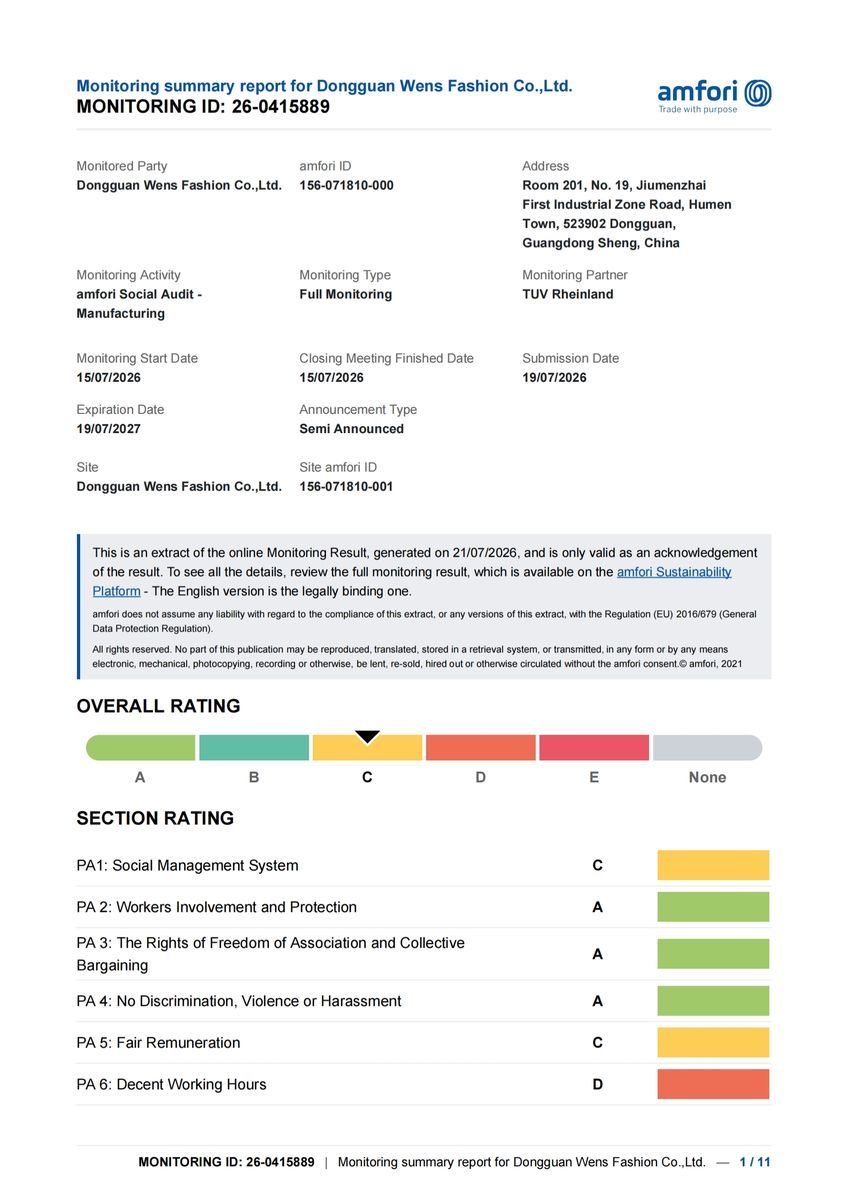
Last month, our activewear factory in Humen, Dongguan completed a Full Monitoring audit under the amfori BSCI framework (Monitoring ID 26-0415889). The audit was conducted by TUV Rheinland, a globally recognised third-party certification body, and the monitoring result is published on the amfori Sustainability Platform — valid through 19 July 2027. For brands and sourcing teams evaluating custom activewear or sportswear manufacturers in China, this is one of the most practical signals of supply-chain integrity you can check before placing a trial order.
What Is amfori BSCI?
The amfori BSCI (Business Social Compliance Initiative) is one of the most widely adopted social-compliance systems for global consumer-goods supply chains. It is run by amfori, a Brussels-based industry association whose members include large European retailers and brand owners. BSCI provides a shared baseline for assessing working conditions, worker rights, fair remuneration, and management systems in manufacturing facilities — and it is accepted in place of many retailers' own proprietary audit programs.
Brands that source from BSCI-monitored factories gain two practical benefits: shorter supplier onboarding time, and a defensible compliance story for their own retail customers and ESG reporting.
Why We Chose Full Monitoring — Not Semi-Announced
BSCI audits come in two main formats. Semi-Announced means the factory knows roughly when an audit might occur; Full Monitoring is the more rigorous version, with the auditor verifying operational reality on the production floor under normal working conditions.
We requested the more demanding Full Monitoring format on purpose. A semi-announced audit can be prepared for; a full one cannot. The result is therefore a much more accurate picture of how we run the factory day to day. The monitoring partner selected to conduct the audit was TUV Rheinland, an international testing, inspection and certification organisation operating in more than 50 countries.
The Results — In Plain English
The amfori BSCI overall rating scale runs from A (strongest) through E (critical non-conformance) plus a "None" category. We received an overall rating of C. Several performance areas — including workers' involvement and protection, freedom of association, and non-discrimination — earned A ratings, which we see as a direct reflection of long-term investment in our workforce.
Other areas, including fair remuneration and decent working hours, received lower ratings. This is consistent with patterns observed across apparel manufacturing in the region and is partly structural — order-season peaks create short-term overtime pressure that the rating framework interprets as a working-hours risk. The full section-level ratings are visible on the amfori Sustainability Platform under the monitoring ID above; we do not edit or contest the published scores.
Continuous Improvement Is the Real Deliverable
An audit report is not a finish line for us — it is a checkpoint. We are using the finding sections of this report to drive a 12-month corrective-action plan covering working-hours management, overtime policy, capacity planning with our brand partners, and wage-structure review. Our next monitoring cycle is scheduled for July 2027, and we will publish the updated result when it is released.
For brand partners who want to see how we are tracking on these commitments, the monitoring report remains the reference document; we are also happy to share our internal corrective-action milestones on request.
What This Means for Your Brand
Beyond compliance, working with a BSCI-monitored factory brings tangible, on-the-ground advantages to your supply chain. Whether you are launching a new activewear line, scaling an existing collection, or switching from a current supplier, here is what we think you should weigh:
- Feature: We hold a current, third-party-verified amfori BSCI monitoring result, valid through 19 July 2027, conducted by TUV Rheinland.
- Advantage: You do not need a separate first-tier social-compliance audit before onboarding — most of our European and North American clients accept the BSCI report in place of their own program, which removes 4–6 weeks of pre-production friction.
- Benefit: Faster order kickoff, lower pre-production audit costs, and a defensible social-compliance story you can show retail buyers, sustainability teams, and licensing partners when they ask who makes your clothes.
Questions We Hear Often
Q. Can I see the full audit report?
The summary is public on the amfori Sustainability Platform (Monitoring ID 26-0415889). The full report is shared on a confidential basis with verified brand clients under NDA.
Q. How does BSCI compare with other standards such as SA8000 or Sedex?
BSCI overlaps with both, but is the most widely accepted framework among European private-label buyers. We can also share data via Sedex if your retail partner uses the SMETA format.
Q. Will I still need to do my own factory visit?
A physical visit is always welcome and recommended for first orders — the BSCI report covers social compliance, not product quality, lead time, or production capacity, which are evaluated separately.

Talk to Us About Your Project
If you are evaluating sportswear, activewear, yoga wear, pickleball apparel, or streetwear manufacturing partners for your upcoming season — and you would like to review our BSCI monitoring report, current capacity, fabric library, or sample program — send us your project brief and we will get back to you with a tailored response.